
![1_olivia_morgan_graphics [Recovered]-01.](https://static.wixstatic.com/media/4f8527_1e23d6b065ef4db4b0bbfdf87a581961~mv2.png/v1/fill/w_346,h_90,al_c,q_85,usm_0.66_1.00_0.01,enc_avif,quality_auto/1_olivia_morgan_graphics%20%5BRecovered%5D-01_.png)


The Ingenuity of Creativity in Ancient Greece
- Olivia Morgan
- May 18, 2019
- 11 min read

Ancient Greece was home to the creation and growth of many things. Much of which, shape our society today. From various new forms of arts and architecture, Greece seems to be the birthplace of it all. A powerhouse of creative ingenuity that would later go on to help shape and be seen throughout the world for centuries to come.
Ancient Greece is home to many of most influential and unique styles of architecture that has shaped architecture throughout the world ,even in today’s society. Greece is home to mainly popular architecture styles such as Minoan, Mycenaean, Classical, Roman, Byzantine, Medieval, Ottoman, Neoclassical, and Cycladic. One example of how these styles are still used today is the Corinthian architecture style which can be seen in the State of Michigan Capital Building as well as the ceiling of the Capitol Building in Washington, D.C.
Taking a look at Classical style of architecture in Ancient Greece, one of the most famous examples in the Parthenon in Athens, Greece. Even back then there was a ridiculous amount of complexity in making a building like that. You have the entablature (comprises the architrave, frieze, and cornice), the architrave (the beam that rests across the columns), the frieze (the band above the architrave; in the Doric order broken up into triglyphs and metopes), the cornice (the projecting area below the pediment, usually consisting of several bands of molding), the triglyph (carved panel on a Doric frieze suggesting the ends of beams), the metope (the panel on a Doric frieze sculpture in relief), the pediment (the triangular section above the frieze; usually filled with relief sculpture) and also the relief (a method of sculpting where figures are partially or completely attached to the stone behind them) (Bunny, pg 1). In addition to that, you also have the Greek’s three different special styles of columns which are known as the Doric (columns with no base and a simple capital, and a frieze characterized by alternating triglyphs and metopes), Ionic (columns with bases, scrolled capitals, and a solid frieze which is either sculpted or left plain), and Corinthian (slender columns topped with elaborate capitals shaped like stylized acanthus leaves, ornately-sculpted friezes, and decorative moldings) (Bunny, pg 1).

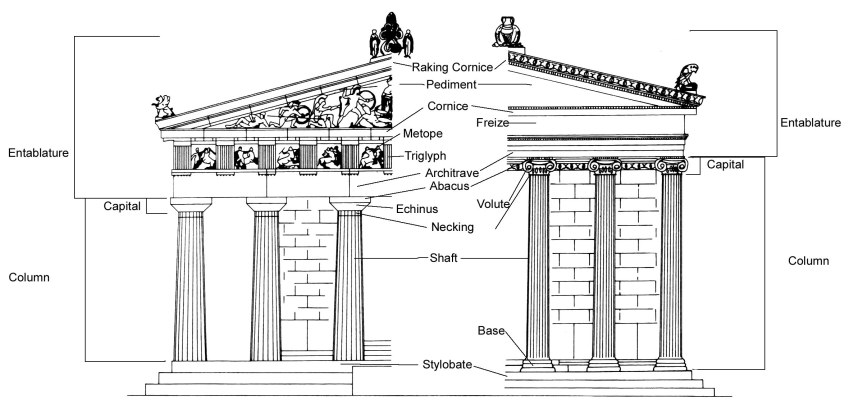
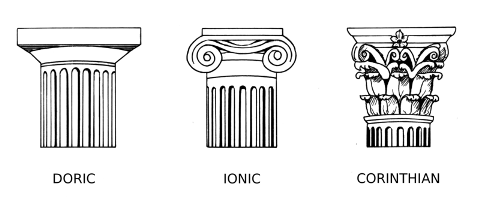
The most influential type of columns is the colonnade which is when the columns are all in align supporting a structure such as what can be seen in the Stoa of Athens in the agora (Bunny, pg 1). Nowadays, we can see all of these different types of architecture featuring columns heavily influenced by Ancient Greece in almost every major capital across America and even many European nations such as with Neoclassical architecture in the late 18th through mid-19th century which was used to build the Irish Houses of Parliament building, the Federal style (mainly between about 1780 and 1830) which has both columns and colonnades heavily influenced by Greece such as both Thomas Jefferson’s home and the campus of the University of Virginia in Charlottesville (Bunny, pg 1). The Greek Revival architecture which grew popular in the middle of the 19th century is still today the most popular style of which can be directly linked back to Ancient Greece (Bunny, pg 1). Second Bank of the United States (built between 1819 and 1824) used the Doric Order style of columns which can be spotted supporting America’s White House, also supports Greek buildings such as the famous Parthenon and the Temple of Hephaestus (Bunny, pg 1). It is thanks to Ancient Greece that today we have not only columns but also theaters, monuments, spas and bathhouses, aqueducts (technically invented by the Romans, but it was the Greeks that first inspired them due to their invention of underground canals).

When it comes to discussing the arts and architecture in Greece, Mistra is also up there on the list of unique styles that can be found in Greece as it is home to some of the most significant examples of residential architecture of the Late Byzantine period as well as numerous art forms and paintings. “Worthy architects, builders, sculptors, painters, scribes, and miniaturists complete the picture of artisans who worked in Mistra over a span of 200 years, attempting to meet the high expectations of aristocratic patrons and members of the court with Constantinopolitan standards and taste. This class, open to ideas from the West, resided in Mistra in luxury, as evidenced by their elegant clothing recorded in portraits and comfortable houses explored in archaeological excavations. At the same time, the city’s numerous chapels, both private and parish, may be associated with the middle class, which resided in more modest dwellings but participated dynamically in the city’s activities. Mistra was created after the reconquest of Constantinople in 1261 as an outpost against the Franks in the Peloponnesos. From the fourteenth century on it grew into an important intellectual and cultural center with artistic preeminence in the Peloponnesos (Albani and Chalkia, pg 239). While a lot of the art and architecture in Mistras is a combination of different countries and time period influences, it is still worth mentioning due to its unique mix of styles that contributed to the European Renaissance.


Of the many major inventions, architectural advancements, and influential art forms that has its roots in ancient Greece, their theaters is one of their finest. The Theater of Dionysus Eleuthereus in Athens as well as the theater in Delphi and in Epidaurus are three of Ancient Greece’s most well known theaters. It must first be noted that it is the Greeks that can be thanked for giving us different styles of theaters buildings/stadiums such as amphitheaters (which we now almost always see American professional football in) as well as crescent style theaters. This is in part due to the Greek’s invention of geometry. While there is no doubt about it that geometry itself has changed and shaped the world we live in such as giving us maps, better navigation and even astronomy, it also has a huge impact of the world of theater. The geometry used to create theaters such as this one is directly responsible for the beautiful acoustics which allows the sound of the actors and orchestra to reach far away and still retain its quality. It is Greek strides and inventions such as this theater and geometry that have allowed us to later create amazing and famous theaters such as Shakespeare's Globe Theater as well as even Carnegie Hall in New York City which is rated as today being the theater with the best acoustics in the world.

Taking a closer look at the theater in Epidaurus, Greece, it can be seen that geometry was the fundamental basis of creating an architectural structure of its size and shape even back then. “The basic unit of measurement for the theater and indeed for many of the fourth century BC monuments was the Pheidonian ell, which corresponded to one and a half Doric feet, or 19.3 inches. Laid out flat, the radius of the outermost circle of the theater is 120 ells. The radius to the inner circle, or Diazoma, is 80 ells which is probably the extent of the fourth-century BC construction. Indications are that the Upper Cavea of 21 rows was added in the second century BC, no doubt following through the geometric implications of the original design. The final construction creates a seating arrangement in which the Upper Cavea has 21 rows and the lower 34. The ratio of 55 (the total number of rows) to 34 is 1.618, which is the ruling number of the Golden Proportion. The same is true of the ratio of 34 to 21. Sacred numerology reveals several remarkable relations: 55 is the sum of the first ten digits added together, with 21 the sum of 1 through 6 and 34 the sum of 7 through 10. As Doxiadis pointed out in his analysis of architectural space in Greece, planners used either a ten- or a twelve-part system in designing and placing a given building on its site. At Epidauros, the base was ten in all measurements. The aisles of the theater, for example, radiate out at an angle of 18 degrees (360 degrees divided by 20, or base ten). The resulting design focuses our attention on the center of the orchestra very much the way a magnifying glass focuses the rays of the sun upon a burning point” (Geldard, pg 259). One of the most beautiful parts of the Greeks’ invention and use of this geometry is their invention of the Golden Ratio and Rule of Thirds and it is this that I would argue is probably their most influential advancement on art and architecture event today. “To ignore the Golden Section, a.k.a. the Rule of Thirds, is to ignore the natural order of the very universe we live in. The rule of thirds “grid” really can serve you well. It can and should often serve as the foundation of a compelling image, much as a firm and solid foundation should be the basis of every house or skyscraper” (ALC, pg 1). While the Golden Ratio (sometimes known as the Golden Proportion or Golden Section) was technically first used by Egyptians to build the pyramids, it wasn’t actually developed and identified until Greek mathematician, especially Pythagoras realized and started studying it. This was later continued by Euclid, another Greek mathematician, who added to the Golden Ration by later developing the Golden Mean (a dividing line between the extreme and mean ratio), which later was used to construct the pentagram. This rule essentially states that “when any object or shape had two distinct parts, the smaller part should be 2/3 the size of the larger part” and should then be placed in one third of the frame (ALC, pg 1). Once this was realized and the word spread, artists and architects across Greece began to use the Golden Ratio in their

works. The Parthenon in Athens is one of the most famous example of this as it was designed and constructed using the Golden Ratio, but it can also be seen in many other Greek buildings such as the Temple of Zeus at Olympia. It was Pythagoras as well that discovered that the human body is actually based on the Golden Ratio (ALC, pg 1). This too led to a change in how art was made, and can be seen in Greek sculptures such as the Statue of Zeus which is now considered one of the Seven Wonders of the World. Thanks to the Greeks, we can now see this widely used throughout the centuries and throughout the world. The Golden Ratio and Rule of Thirds is always one of the first things to be taught in film, photography, architecture, and design courses. It can be seen in Leonardo Da Vinci’s famous Last Supper Painting, the Mona Lisa, and architectural masterpieces such as that created by Frank Gehry and often as well accidentally used by many who do not even see or realize the geometric brilliance that have applied to their art or that can be seen everyday in the world around them.

In addition to the influential strides that the Greeks took advancing the world of paintings, geometry, Golden Ratio, and architecture, it is also important to note the advancements they made artistically within the walls of their architecturally advanced theaters and stadiums that I wrote about above. Widely known Greek plays such as Oedipus the King and Antigone, both written by Sophocles, is a perfect example of the artistic theatrical and literary strides taken back then, partially due to the Greek’s invention and expansion of what is now known as Greek tragedies. “The problematic relationship between gods and humans formed the basis of Classical Athens’s most enduring cultural innovation: the tragic dramas performed over three days at the major annual festival of the god Dionysus held in late spring. These plays, still read and produced on stage today, were presented in ancient Athens as part of a drama contest, in keeping with the competitive spirit characteristic of many events held in the gods’ honor. Athenian tragedy reached its peak as a dramatic form in the fifth century b.c. as did the comedy, the other equally significant public drama of Athens” (Martian, pg 130). Throughout the centuries, you can find other plays that have been influenced by Greek tragedies. For example, if you take a look at Shakespeare's play Hamlet, it actually closely mirrors the plot of the famous Greek tragedy Orestes. In both, the play’s main characters go insane and seek revenge which leads to the death of their parents and spouses. And if you look at many other plays of Shakespeare's you will see plenty of references to the Greek gods and goddess. In A Midsummer Night’s Dream you find references to Theseus, the queen of the Amazons, the Minotaur and Hippolyta, Cupid, Aphrodite, Elissa, Aeneas, Apollo, Heracles, the Fates, and many more.
Another main influence that Ancient Greece had on the world of theater is it is the origin of the first ever named actor. “On November 23, 534 BCE, legend holds that the performer known as Thespis of Icaria (now Dionysos, Greece) recited lines as someone other than himself—becoming the world’s first actor. Before this time, theater performances were either storytelling or “choral” productions. Storytellers not only told stories of Greek gods and heroes, they also danced and sang. A Greek chorus was a group of between 12 and 50 performers who spoke in unison and often wore masks. Thespis was allegedly performing as part of a chorus when he stepped forward. He spoke lines written for the chorus by himself, in character as the Greek god Dionysus” (Caryl-Sue, pg 1). Thanks to Thespis, actors are now called “thespians” which has led to stuff annual events such as the International Thespian Festival as well as the International Thespian Society.

In addition to being performed as mentioned above, the works of writers such as Homer and Euripides would actually be set to music. Which brings me to my final topic and final example of creative ingenuity that can be found in ancient Greece: Music. The ancient Greeks viewed music as a gift from the gods (Hermes, Pan, and Athena were three of the most common) as well as the instruments they had and used to play the music as well (Cartwright, pg 1). “One of the unique contributions the Greeks made to the history and development of music is that it can have a moral and emotional effect on the listener and his or her soul; in short, that music has an ethical role in society. For this reason, Plato, considering them rather decadent , banned instruments capable of producing all of the scales. Likewise, over-complicated rhythms and music with too fast a tempo were considered morally dangerous in the great philosopher’s ideal republic” (Cartwright, pg 1). They also thought that music had a beneficial effect, and even medical powers, on one’s mind and body (Cartwright, pg 1). “The combining of words and music, melodic and scalar systems, and several of the most popular musical instruments such as the aulos and lyre probably derived from the Near East. However, the Greeks themselves considered the lyre, in particular, as a ‘Greek’ instrument whilst the aulos is often represented in mythology as an inferior foreign competitor of Eastern origin. Hence, the great Greek god Apollo, who was believed to be the master of the lyre, defeated the Phrygian Satyr Marsyas and his aulos in a musical competition judged by the Muses. The lyre was also the musical instrument, above all others, which young Greeks had to learn in their schooling and was recommended as such by Plato in his Republic” (Cartwright, pg 1). These instruments included stringed, wind, and percussion (Cartwright, pg 1). In addition to this, it is the Greeks that can be thanked for the invention of music theory as well as music becoming an element of philosophical study (Cartwright, pg 1). “The earliest surviving (but fragmentary) text on the subject is the Harmonic Elements by Aristoxenos, written in the 4th century BCE. Music also became an element of philosophical study, notably, by the followers of Pythagoras, who believed that music was a mathematical expression of the cosmic order” (Cartwright, pg 1). In addition to this, the Greeks can be credited with having the very first music school which was founded in Athens during the 6th and th centuries BCE (Cartwright, pg 1). Students between the ages of thirteen and sixteen were taught there to play instruments and sing (Cartwright, pg 1). They used music to teach discipline and taught the students to have a better appreciation of musical performance (Cartwright, pg 1).
Ancient Greece was home to the creation and growth of different forms of architecture and art from their creation of geometry and the Golden Ratio, to their advancements in theater, and even their creation of music theory. These are only a few of the many areas in which creativity ingenuity and advancements in the arts in ancient Greece still shape our society today.
Works Cited
Bunny, Brainy. “The Influence of Ancient Greek Architecture.” Owlcation, 8 Apr. 2018,
owlcation.com/humanities/The-Influence-of-Ancient-Greek-Architecture.
Caryl-Sue. “World's First Actor Takes the Stage.” National Geographic Society, 20 Oct. 2014, www.nationalgeographic.org/thisday/nov23/worlds-first-actor-takes-stage/.
Cartwright, Mark. “Ancient Greek Music.” Ancient History Encyclopedia, Ancient History
Encyclopedia, 5 Jan. 2013, www.ancient.eu/Greek_Music/.
Caryl-Sue. “World's First Actor Takes the Stage.” National Geographic Society, 20 Oct. 2014,
www.nationalgeographic.org/thisday/nov23/worlds-first-actor-takes-stage/.
Meisner, Gary. “History of the Golden Ratio.” The Golden Ratio: Phi, 1.618, 13 May 2012,
www.goldennumber.net/golden-ratio-history/.
N/A. “What Is the Rule of Thirds.” ALC, 22 Feb. 2012,
www.adorama.com/alc/0013581/article/FAQ-What-is-the-Rule-of-Thirds.


Comments