
![1_olivia_morgan_graphics [Recovered]-01.](https://static.wixstatic.com/media/4f8527_1e23d6b065ef4db4b0bbfdf87a581961~mv2.png/v1/fill/w_346,h_90,al_c,q_85,usm_0.66_1.00_0.01,enc_avif,quality_auto/1_olivia_morgan_graphics%20%5BRecovered%5D-01_.png)


The Conversation (1974) - The importance of sound effects
- Olivia Morgan
- Jan 26, 2018
- 4 min read
Updated: Oct 14, 2019

The Conversation is a 1974 movie directed by Francis Ford Coppola that follows the story of a secret surveillance detective named Harry Caul (played by Gene Hackman) who becomes paranoid as he begins to suspect the murder of a couple he has been spying on. The paranoia in this film is can be roughly broken down to the sound effects in this movie and the meanings behind them.
We are first introduced to this crazy cinematic soundtrack at the very beginning of the movie. From the very beginning, we are introduced to a scene of people living their lives in a park as we begin to hear over lapping footsteps, shuffling, conversations, and even music playing in the background. From there, we are soon introduced to the couple Ann and Mark as we first begin to hear their conversation which is then abruptly interrupted by the overlaying sound of the crackles, beeps, and pops of technology. When comparing it to the way the audience was treated when watching the movie Blow Up (which I discuss in another article), it is similar the factor of not letting the audience in on all of the information and what is going on. It is as if knowledge and information is not yet something we are privileged to. As the movie progresses, we are treated similarly as The Conversation takes about 1/3-3/4 of the movie before explaining to us information such as Harry's job, why he is trailing the couple, where he lives, and anything about his past of celebratory in the community.
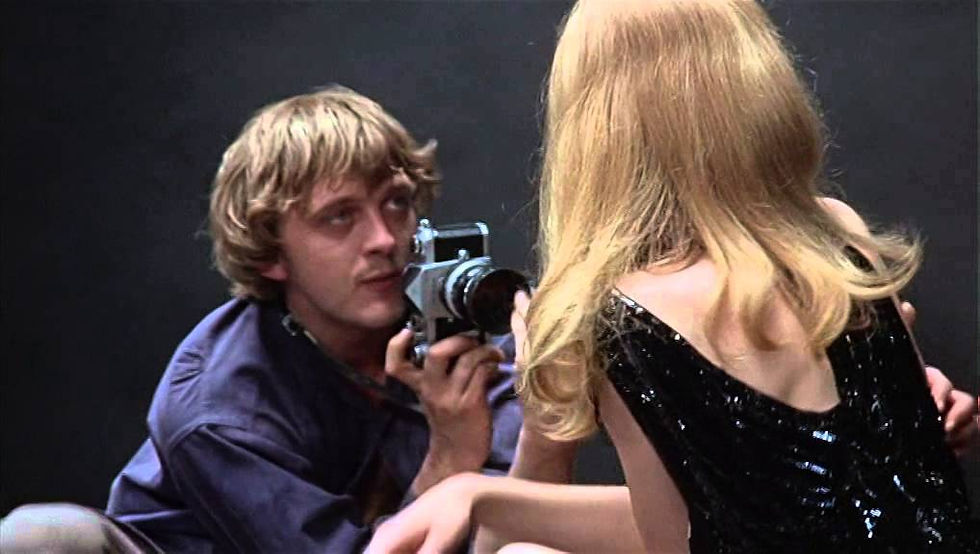
Like the movie Blow Up, this movie also understands the importance of making an audience look for and wait for realizations and information to help create paranoia however the mange and go about this technique in a very different way. In both movies, the protagonist lacks the prospective of others. Living in an emotionally alone, self-centered, secluded world, we are able to see the protagonist go about their daily lives, never wondering or caring how their actions affect others. It wasn't until Thomas discovered the danger revolving the couple in the photographs and until Harry discovered the danger revolving the couple he was trailing, that either of them was able to finally begin to wake up and begin to experience emotional connection, curiosity, and/or perspective that later changed them. Whilst in neither situation the character was specifically interested nor affected by the danger directly, they both were drawn in by connection and the want to understand how they fit in to the events that are unfolding. They both went about their lives absorbed in their crafts, came across a woman who made them question their involvement, sensed something was more than what it seemed, found out about potential danger, potential danger, obsessed over the situation, and then ended up changed men. Only difference is one is for better and one is for worse, and one is through his photographs and the other is through his audio recordings. Which is why it is relatively safe to say that in both of these movies, the paranoia is not in the murder attempt or danger, it is both within the lack thereof and is also within the questions. It is not about the violence at all.
Although the audio effects and soundtrack in The Conversation takes its paranoia mostly from timing, location, relevancy, types, and mood of the scene, it also seems to have taken a specific level of underlying pre laid fear in society and statistics into account. The scene that I found the audio effects to be the most interesting is the elevator scene. Now although that scene may not be the absolute highlight of paranoia in this film, it does however have a very specific and interesting choice of sound design making a very distinctly similar and recognizable sound of an airplane landing and hitting the runway. I found that intriguing considering that the fear of flying (aerophobia) is ranked as the 7th most common fear in the U.S. (affecting roughly 6.5% of the U.S. population). And while this sound effect is taking over the screen, they are in an elevator which takes into account the fear of being confined in small places (claustrophobia) which is ranked as the 8th top fear in the U.S. (affecting 2.5% of the U.S. population). AND, this elevator is becoming more and more crowded with people which takes into account the fear of people or social situations (sociophobia) which is ranked as the number 6th top fear in the U.S. (affecting 7.9% of the population). Which brings me to the conclusion that in this one tiny scene, even though it may not be the highlight of paranoia in this movie, was specifically planned as one of many examples of ways to subconsciously inflict paranoia in the audience whilst complimenting but not taking away from the main story-line whilst probably making at least a percentage of the movie's audience members shift uncomfortably in their seats due to a set mood of paranoia in this scene. After all, as Dan Schneider states in the article 'The Conversation': Francis Ford Coppola Paranoid Classic, “There are many watchers in this film, yet the final watcher is the audience. And what they watch is greatness, simple in its complexity, for The Conversation is a small, simple, great film”.


Comments